
77 Elm St, Amesbury, MA 01913 978-233-9597
Verify Insurance Admissions 24-Hour Admissions
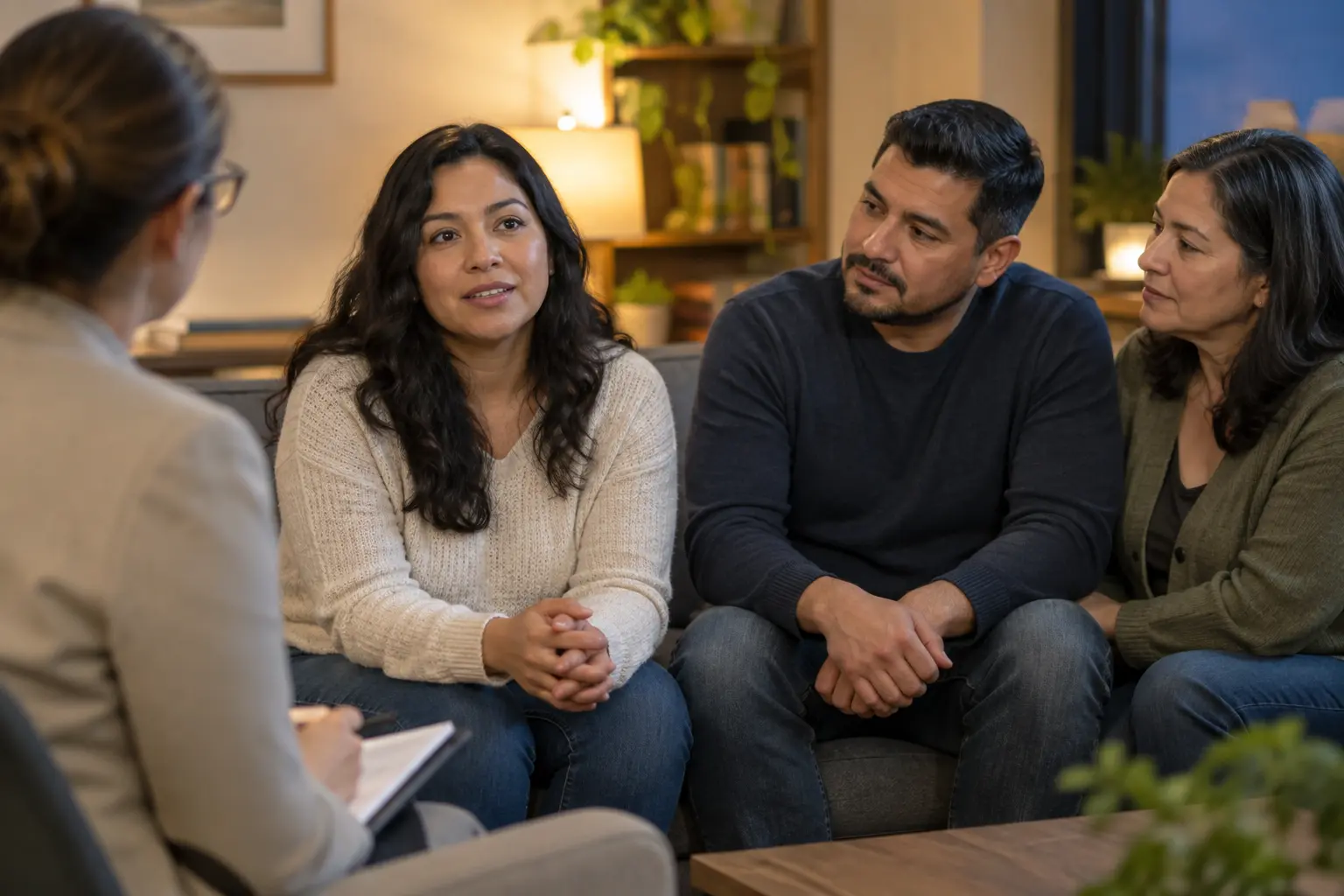
A Latina woman in her thirties and family members meet with a therapist.

Readiness and Participation for Family Therapy

Approved by Clinical Staff

Readiness for family therapy centers on whether the person in care wants family members included and how participation can support the treatment process. At MVBH, this decision sits within an evidence-based approach for mental health and substance use challenges. Readiness may be revisited rather than treated as a permanent choice.

What readiness means in this family therapy context

Start with MVBH’s therapies family therapy overview, then compare the broader therapy services context. Readiness here is a participation decision anchored in the person’s preference and the defined role of family members in treatment.

MVBH defines family therapy as an evidence-based treatment approach that involves family members in the recovery process. The stated subjects are mental health and substance use challenges. This establishes the service concept without deciding whether participation is appropriate for a particular person.

SAMHSA notes that family members can be included as desired by the person in care. Accordingly, readiness should not be reduced to family interest alone. The person’s own preference is a necessary part of the participation conversation. The available evidence does not define a required family structure, attendance pattern, or number of participants.

Decision factors for participation

Review therapy services alongside MVBH’s outpatient treatment programs. The decision is not simply whether relatives are interested. It begins with the wishes of the person in care and a clear purpose for family involvement.

A useful decision separates three questions. First, does the person want family members included? Second, is there a shared understanding that participation is part of the treatment process? Third, are expectations about involvement clear enough for a next-step discussion?

These questions organize the known facts without turning them into clinical criteria. The evidence supports desired inclusion and a recovery-oriented role for family members. It does not specify who should attend, what should be discussed, how often participation occurs, or which outpatient program should contain the service.

Evidence boundaries for a readiness decision

The outpatient treatment programs page provides verified scope, while progress review for family therapy addresses a later decision point. Readiness should remain within the evidence: desired family inclusion, participation in treatment, and the defined mental health and substance use context.

The evidence identifies family therapy as evidence-based and names family inclusion as a possible part of treatment. SAMHSA also lists other evidence-based practices, including motivational interviewing, CBT, CPT, psychoeducation, supportive therapy, social skills training, and behavioral management training for youth. That list does not prove that every practice is used in every family therapy situation at MVBH.

MVBH’s locked program scope is PHP, IOP, OP, Virtual IOP, and Dual Diagnosis. This scope should not be read as proof that family therapy has the same format within each program. It also does not establish access, outcomes, coverage, or individual suitability.

Connecting readiness with continuity

Use progress review for family therapy to understand the later review stage, and consult MVBH admissions for organizational next-step context. A readiness choice can be kept distinct from any later assessment of participation.

Readiness and progress review answer different questions. Readiness concerns whether and how family members may enter the treatment process. Progress review concerns reflection after participation has begun. Keeping these stages separate prevents an early preference discussion from being treated as evidence of later progress.

Continuity also means carrying the person’s participation preference forward as a relevant decision point. The supplied evidence does not describe documentation, reassessment schedules, or changes in family roles. It does support returning to the core question of whether family inclusion remains desired by the person in care.

Preparing for the next conversation

For general process context, visit MVBH admissions, then review the broader mental health conditions route. Prepare to discuss the person’s preference, the proposed family role, and how participation connects to the treatment process.

A focused next-step conversation can begin with the person’s wishes. It can then clarify which family relationships are being considered and what involvement is intended to contribute to the treatment process. These are discussion prompts, not criteria for acceptance or a recommendation for a particular service.

The MVBH family therapy description covers recovery related to mental health and substance use challenges. The conditions page can provide broader subject context, while admissions can address organizational questions. Neither linked route should be taken as proof of current access, insurance coverage, expected outcomes, or placement in PHP, IOP, OP, Virtual IOP, or Dual Diagnosis.

A readiness and participation check

  • Confirm the person’s preference about family involvement
  • Identify what participation should contribute to treatment
  • Discuss who may participate and in what way
  • Revisit participation when preferences or treatment needs change
FAQ

Frequently Asked Questions

Does every family member need to participate?

No. SAMHSA states that family members can be included in treatment as desired by the person in care. That makes the person’s preference central to the participation decision. Family therapy involves family members in the recovery process, but the supplied evidence does not establish that every family member must participate.

How is readiness for family therapy determined?

The supplied evidence does not define readiness as a formal score or fixed threshold. A practical reading is whether the person in care desires family inclusion and whether the proposed participation has a clear connection to the treatment process. This page does not determine individual suitability or prescribe a level of care.

Can the participation decision be revisited?

Yes, participation can be framed as a choice that may be discussed again. SAMHSA’s wording places family inclusion under the desires of the person in care. The evidence does not describe consent procedures or timing, but it supports keeping the person’s preference visible whenever family involvement is considered.

Can family therapy relate to mental health and substance use challenges?

MVBH describes family therapy as involving family members in recovery for both mental health and substance use challenges. Its verified program scope also includes Dual Diagnosis. These facts establish subject areas and program scope only. They do not establish individual fit, expected results, access, insurance coverage, or a recommended program.

What can be discussed before moving forward?

A next-step conversation can focus on the person’s preference for family inclusion, the intended role of participation, and any questions about the treatment process. MVBH admissions provides an organizational route for general admissions information. The supplied facts do not establish scheduling, current availability, coverage, or an individual care recommendation.

A clear next step starts with a conversation.

Call MVBH or review plan-specific benefits.

If you are in crisis or having thoughts of suicide: call or text 988 (Suicide & Crisis Lifeline) or 911. MVBH is not an emergency service.