
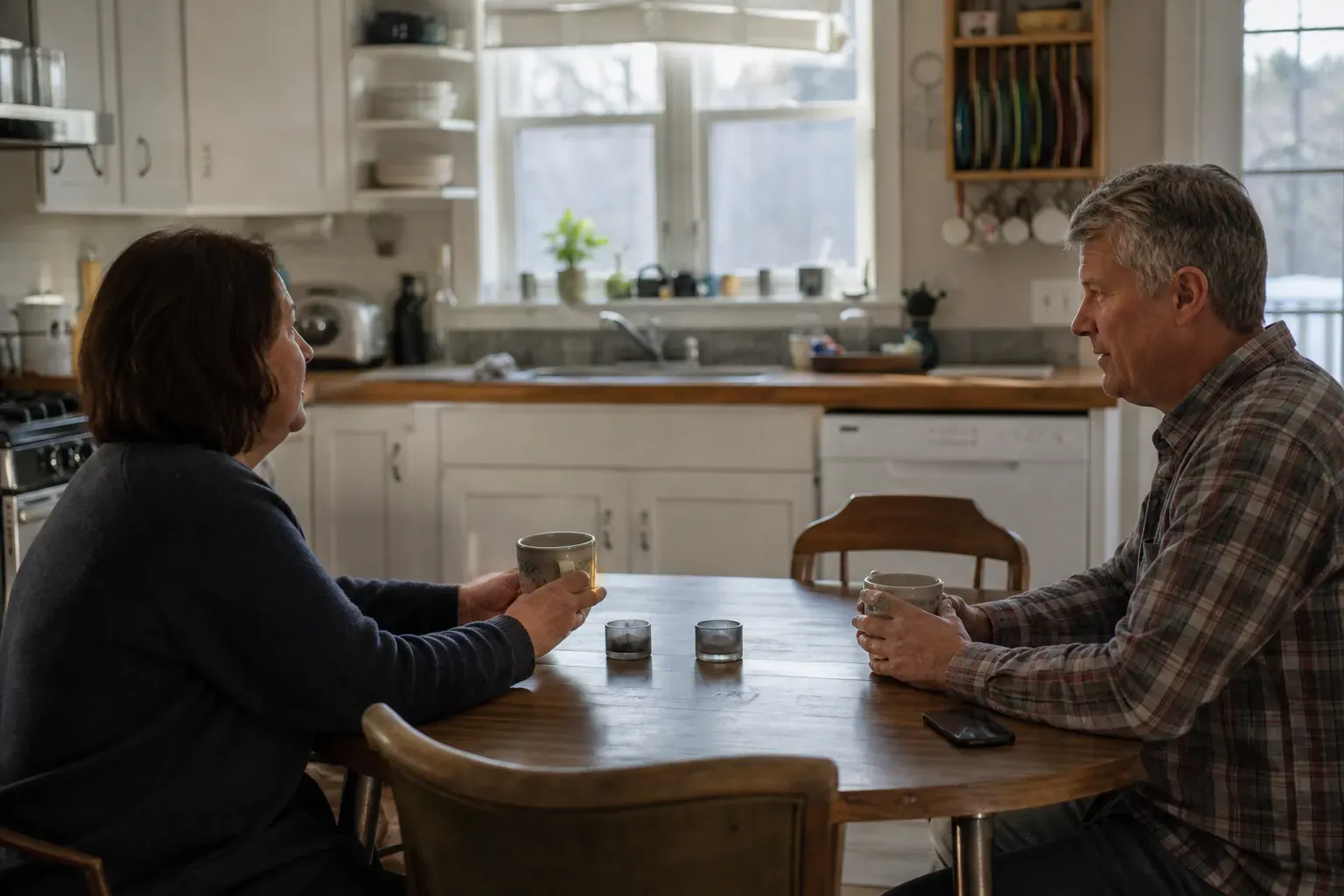
If you keep asking, “Am I attracted enough?” you may feel pressure to solve the question before you can enjoy time with your partner. Searches for “relationship OCD attraction” often begin here: not with one passing doubt, but with repeated attempts to measure feelings. Attraction concerns alone do not establish an OCD diagnosis or reveal whether a relationship is right for you. This article focuses on when monitoring can become a ritual. For broader context, start with Relationship OCD: Understanding Doubt and Treatment.
Key takeaways
- Attraction doubts can occur with or without OCD; their content alone does not establish a diagnosis.
- Repeated scanning, comparing, and reassurance seeking can become attempts to eliminate uncertainty.
- Treatment focuses on changing your response to doubt, not proving attraction or deciding compatibility for you.
- Safety concerns and relationship boundaries deserve attention, whether or not OCD is present.
What does relationship OCD attraction anxiety mean?
Relationship OCD is a commonly used term for OCD symptoms centered on a romantic relationship. It describes a theme of symptoms, rather than a separate diagnosis. Attraction-focused concerns might involve a partner’s appearance, your physical response, or whether your feelings match an imagined standard. A clinician considers the broader pattern, including intrusive thoughts, compulsions, distress, and interference with daily life.
The National Institute of Mental Health’s overview of OCD explains that obsessions are recurring, intrusive thoughts, urges, or images, while compulsions are repetitive behaviors people feel driven to perform. Some rituals happen internally. Mentally reviewing a date can be less visible than repeatedly asking a question, but both may serve the same goal: trying to feel certain.
A thought such as “What if I am not attracted to my partner?” does not, by itself, tell you whether you have OCD. The important questions include what happens next, how much time the response takes, and whether your efforts to settle the doubt keep pulling you back into it.
When does checking attraction become a ritual?
Checking becomes concerning when it functions as a repeated test you feel compelled to complete. You might look at your partner and immediately inspect your reaction, then repeat the test because the result did not feel clear enough. The goal shifts from sharing an experience to producing evidence about your feelings.
The cycle may look like this: a doubt appears, anxiety rises, you check, and you feel some relief or find a new reason to worry. Either outcome can lead to another check. MedlinePlus describes how compulsions may offer temporary relief without resolving the underlying OCD pattern. The specific ritual can change while the demand for certainty stays the same.
- Scanning your body for excitement during a kiss or a conversation.
- Comparing your response to your partner with your response to strangers or photographs.
- Reviewing early dates to determine whether your attraction was “real.”
- Asking friends, your partner, or online communities to interpret your feelings repeatedly.
- Testing attraction by arranging contact, then avoiding contact when the test feels threatening.
- Repeating an internal phrase until you briefly feel convinced.
Frequency alone is not the whole picture. A clinician also asks whether the behavior feels driven, what you hope it will resolve, and how it affects your day. Our article on relationship OCD and checking your feelings explores this broader pattern of internal monitoring.
Ready to start treatment?
MVBH's outpatient mental health program in Amesbury, MA, plus Full Day and Half Day Treatment, gives adults structured, evidence-based care without a hospital stay. Call 978-233-9597 today or verify your insurance in minutes.
How is a checking cycle different from relationship reflection?
Thoughtful relationship reflection can involve difficult questions. You may need to discuss affection, sexual preferences, boundaries, or recurring conflict. OCD assessment should not replace that reflection or dismiss concrete concerns. The distinction often lies in the process: are you gathering useful information and choosing a next step, or repeatedly reopening the same question to obtain a particular feeling?
| Pattern | Purpose and response | Possible next step |
|---|---|---|
| Purposeful reflection | Considers specific experiences and allows a decision or conversation without complete certainty. | Identify the concern and discuss it at a planned time. |
| Possible compulsive checking | Repeats tests or reviews until an answer feels right, then questions that answer again. | Discuss the cycle with a clinician familiar with OCD. |
| Safety or boundary concern | Responds to specific behavior such as threats, coercion, or pressure to ignore consent. | Prioritize safety and seek appropriate support. |
These patterns can overlap, and this table is not a diagnostic tool. Attachment patterns, depression, stress, and other experiences may also affect how someone relates to a partner. If withdrawal is part of your concern, Relationship OCD vs. Avoidant Attachment discusses why similar-looking behaviors may need different explanations.
A useful assessment leaves room for more than one factor. You do not need to prove that every concern is “just OCD” before seeking help. Likewise, an OCD diagnosis does not require you to stay in a relationship or excuse behavior that violates your boundaries.
Why can reassurance and comparison keep the doubt going?
Reassurance can feel caring and reasonable. You may ask, “Do other couples feel this way?” or search for stories that match your experience. General education can be helpful. But when you return to the same information to remove anxiety each time a doubt appears, reassurance may become another checking behavior.
Comparisons can work similarly. You might compare today’s feelings with a vacation memory, or compare your partner with someone you briefly noticed. The comparison rarely settles the issue because another condition can always be added: “But what if I would feel more tomorrow?” The standard for a convincing answer keeps moving.
Partners can acknowledge distress without providing a verdict about attraction. For example: “I can see this is difficult. I don’t think another analysis of your feelings will help right now.” This should not become punishment, emotional withdrawal, or a refusal to discuss real relationship needs. When possible, agree on a supportive response with a clinician rather than abruptly changing how you communicate.
How can treatment address attraction doubts without giving certainty?
OCD treatment focuses on the relationship between intrusive thoughts and responses to them. It does not promise to establish whether you are attracted enough or whether you should remain with a partner. MVBH’s OCD treatment information can help you begin exploring care and assessment.
NIMH identifies cognitive behavioral therapy, including exposure and response prevention, or ERP, as an OCD treatment. In ERP, a person gradually encounters triggers while practicing not performing the associated compulsion. Medication may also be part of treatment after an evaluation with a qualified prescriber. Decisions should reflect your symptoms, health history, preferences, and clinical needs.
For attraction-related checking, a clinician might help you practice having an ordinary conversation without repeatedly scanning your reactions, or allowing an unanswered doubt without reviewing photographs for proof. The goal is not to force attraction, create a particular emotional state, or endure unwanted intimacy. Exposure work should respect consent, personal boundaries, and relationship safety.
Learning to tolerate uncertainty also does not mean labeling every thought meaningless. It means reducing ritualized attempts to settle a question immediately so you have more room to live and consider choices. Treatment can support that process, but it cannot guarantee a specific feeling or relationship outcome.
What can you try when you notice yourself monitoring attraction?
Start by noticing the sequence rather than deciding what your latest feeling means. If a clinician has given you a treatment plan, follow that guidance. Otherwise, these steps can help you describe the pattern and prepare for an assessment without turning self-help into another test.
- Name the behavior. Describe it simply: “I am comparing reactions again,” rather than debating whether the comparison proves something.
- Notice the demand. Ask whether you are trying to get useful information or eliminate all uncertainty right now.
- Return to the activity. Continue the conversation, meal, or task without repeatedly evaluating whether redirecting attention worked.
- Keep boundaries intact. You do not need to agree to physical affection or sexual contact to challenge checking.
- Seek support when the pattern persists. Bring examples of rituals, avoidance, time spent, and daily disruption to a clinician.
These steps are not a way to make attraction appear. If you begin checking whether you are “accepting uncertainty correctly,” that can become another loop. Progress does not require a calm feeling after every trigger. The practical focus is changing your response, with professional guidance when needed.
When should you seek help for attraction-focused OCD concerns?
Consider an assessment if doubt and checking interfere with work, sleep, intimacy, or everyday decisions, or if you feel increasingly trapped by reassurance seeking and avoidance. You do not need to reach a certain level of distress before asking for help. Bring concrete examples rather than trying to determine your own diagnosis first.
Merrimack Valley Behavioral Health is an adult outpatient mental health treatment center at 77 Elm St, Amesbury, MA 01913. Depending on assessed needs, options include Outpatient care and Half Day Treatment, called IOP by insurers. Virtual IOP is available for people physically in Massachusetts. Call 978-233-9597 to ask about assessment and program fit; availability of a specific treatment approach should be discussed directly.
MVBH is not an emergency service. If you are in emotional crisis, call or text 988. Call 911 for emergencies. Seeking support does not require deciding today what your attraction doubts mean; it can begin with describing how the cycle is affecting your life.
Frequently asked questions
Does doubting attraction mean I have relationship OCD?
No. Attraction doubts alone do not establish OCD, and they do not determine whether a relationship is right for you. A clinician looks at the larger pattern: intrusive thoughts, repetitive checking or reassurance seeking, distress, and interference with daily life. Assessment can also consider relationship circumstances and other mental health concerns. You can seek help without first deciding whether your experience fits an OCD label.
Can checking my physical response become a compulsion?
It can, especially when you repeatedly scan your body to obtain certainty and feel driven to repeat the test when the answer seems unclear. The concern is the function and impact of the checking, not one particular physical response. A clinician can help assess this pattern. You should never feel required to engage in unwanted affection or sexual contact to test attraction or challenge OCD.
Should my partner reassure me when I question my attraction?
A partner can acknowledge that you are distressed without repeatedly trying to prove what your feelings mean. When reassurance becomes a ritual, another answer may provide only brief relief before the doubt returns. Ideally, work with a clinician on a shared response that remains warm and respectful. Limiting reassurance should not mean withholding affection, punishing you, or refusing to discuss specific relationship concerns.
Can ERP tell me whether I should stay in my relationship?
ERP is not a compatibility test and does not decide whether you should stay or leave. It helps you practice encountering triggers while reducing compulsive responses, such as checking and mental review. Treatment should respect consent, safety, and personal boundaries. You can work on OCD symptoms while also considering concrete relationship needs, without expecting therapy to guarantee attraction or deliver a completely certain answer.
How can I ask MVBH about care for relationship-focused OCD?
Call MVBH at 978-233-9597 and describe how intrusive doubts, checking, or reassurance seeking are affecting your daily life. Ask about assessment, program fit, and the availability of treatment approaches relevant to OCD. MVBH provides adult outpatient mental health treatment in Amesbury, Massachusetts, with Virtual IOP for people physically in Massachusetts. It is not an emergency service; call or text 988 for crisis support and 911 for emergencies.
Don't wait for things to get worse. Call Merrimack Valley Behavioral Health at 978-233-9597 to start adult care in our outpatient mental health program or compare Half Day Treatment (IOP) and Full Day Treatment (PHP). Same-week assessments may be available.
Editorial status
Reviewed by clinical staff
Written by Tim Francis, SUD Content Specialist. This guide is educational. Read our clinical review and sources policy.
