
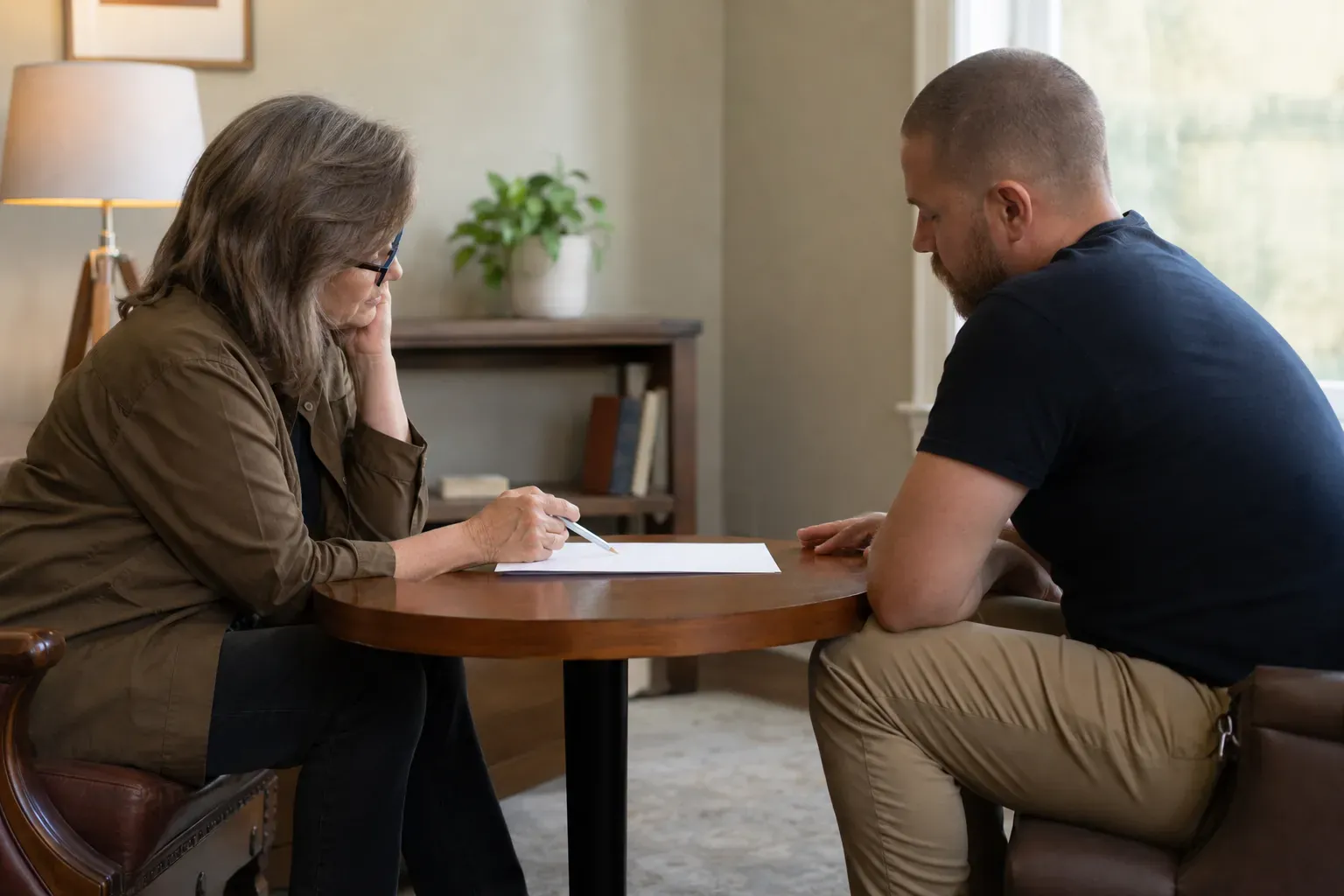
A challenging beliefs worksheet is a structured tool used in cognitive processing therapy (CPT) to examine beliefs that may keep someone feeling stuck after trauma. It is not a test, a demand to forgive, or an instruction to replace painful thoughts with cheerful ones. With compassionate clinician guidance, it can help separate what happened from the meanings someone has attached to it. If you are new to this approach, our adult guide to cognitive processing therapy for PTSD explains the broader treatment process.
Key takeaways
- The worksheet examines a specific interpretation, not whether your trauma or emotions are real.
- A balanced belief can acknowledge harm, uncertainty, and limits while reducing unfair self-blame.
- Clinician support matters, especially when an exercise brings up shame, fear, or emotional overwhelm.
- Completing a worksheet is practice, not proof that you are recovering correctly.
What is a challenging beliefs worksheet in CPT?
CPT is a trauma-focused psychotherapy that helps people examine and change unhelpful beliefs connected with traumatic experiences. The National Institute of Mental Health’s overview of PTSD describes how cognitive approaches can help people make sense of trauma, including guilt about events that were not their fault. A worksheet gives that examination a concrete structure.
In CPT, a strongly held interpretation that interferes with recovery is often called a stuck point. Examples might include “I should have prevented everything,” “Nobody can be trusted,” or “Needing help means I am weak.” These statements can feel like facts, particularly when they developed during frightening or overwhelming circumstances.
The worksheet usually brings together skills practiced earlier in therapy: identifying a situation, noticing thoughts and emotions, examining evidence, recognizing thinking patterns, and developing another way to understand the event. Specific forms and wording can vary. Your clinician can explain which version you are using and how it fits your treatment.
The purpose is not to disprove every painful thought. Some conclusions accurately recognize harm or continuing risk. The work is to notice where a belief goes beyond the available evidence, assigns responsibility unfairly, or turns one experience into an absolute rule about your life.
Which trauma-related beliefs can the worksheet help examine?
Trauma can affect beliefs about safety, trust, power and control, esteem, and intimacy. Someone may intellectually know that danger has passed while still feeling that any uncertainty means another disaster is coming. Another person may understand that someone harmed them but continue to believe they were responsible for stopping it.
Useful worksheet statements are usually specific enough to examine. “I feel awful” names a real experience, but it does not identify a belief. “Because I froze, I caused what happened” provides an interpretation that a clinician and patient can explore together. Identifying the thought is not the same as agreeing with it.
- Safety: “If I relax, something bad will definitely happen.”
- Trust: “Anyone who seems kind is hiding harmful intentions.”
- Control: “I must anticipate every danger to be responsible.”
- Esteem: “What happened means I have no worth.”
- Closeness: “Letting anyone know me will always lead to harm.”
A clinician should also consider actual circumstances, including ongoing abuse, discrimination, unsafe housing, or other present threats. The worksheet should never be used to persuade someone that a genuinely dangerous situation is safe. For broader information about symptoms and treatment, visit our PTSD and trauma page.
Ready to start treatment?
MVBH's outpatient mental health program in Amesbury, MA, plus Full Day and Half Day Treatment, gives adults structured, evidence-based care without a hospital stay. Call 978-233-9597 today or verify your insurance in minutes.
How is a challenging beliefs worksheet used in a session?
A clinician may first help you choose one situation and one stuck point rather than trying to address your whole history at once. You might discuss how strongly you believe the thought and which emotions accompany it. Ratings, when used, are ways to notice patterns—not grades or targets you must reach.
- Describe the situation briefly. Identify what triggered the belief without adding more detail than the exercise needs.
- Name the interpretation. Write a specific thought, such as “I should have known what would happen.”
- Notice emotions and intensity. Identify fear, guilt, sadness, anger, shame, or other responses.
- Examine the belief. Consider supporting information, missing information, and evidence that does not fit.
- Build a balanced alternative. Develop wording that is accurate and personally meaningful.
- Check what changes. Notice whether belief strength or emotions shift, stay the same, or bring up another question.
The clinician may ask what you knew at the time, what was actually within your control, or whether you would apply the same standard to someone else. These questions are invitations to investigate—not a debate you are expected to lose. You can disagree, request clarification, or say a proposed alternative does not feel accurate.
Some practice may happen between appointments, depending on the treatment plan. If you cannot finish, that can become useful information for the next session. Confusing wording, a belief that is too broad, or strong emotional activation may signal a need for more support rather than a lack of effort.
How is this different from forced positive thinking?
Forced positive thinking asks you to arrive at a reassuring conclusion regardless of the facts. A CPT worksheet asks you to slow down and consider the facts more fully. An alternative belief does not need to feel happy. It needs to be more accurate, flexible, and fair than the stuck point.
For example, replacing “Nothing is safe” with “Everything is safe now” may ignore real concerns. A more balanced statement might be: “I cannot eliminate every risk, but some situations are safer than others, and I can use information and support to make choices.” The difference is accuracy, not cheerfulness.
| Approach | What it may sound like | What it does |
|---|---|---|
| Forced reassurance | “Just focus on the good.” | Can bypass pain and leave the original belief unexplored. |
| Arguing with yourself | “I am irrational for thinking this.” | Adds judgment instead of helping you understand the belief. |
| Compassionate examination | “What did I know then, and what was outside my control?” | Looks at context, responsibility, and available evidence. |
| Balanced alternative | “I wish the outcome had been different, but wishing does not mean I could have prevented it.” | Allows grief while questioning an unfair conclusion. |
Emotion may not change immediately when a new interpretation makes sense. That does not automatically mean the exercise failed. Your clinician can help explore the gap between understanding a belief intellectually and feeling it emotionally, without pressuring you to report improvement you do not feel.
What might a compassionate worksheet example look like?
Consider a fictional adult who feels guilty for not recognizing a threat earlier. Their stuck point is “I should have known, so what happened is my fault.” A careful discussion would distinguish what is known now from what was reasonably available then. Knowing the outcome afterward does not mean the person could have predicted it beforehand.
The clinician might ask: Were warning signs clear at the time? Was information deliberately hidden? What choices were realistically available? Who made the decision to cause harm? These questions should not imply that the person needed to behave perfectly to deserve safety. They help separate hindsight, regret, and responsibility.
A possible alternative could be: “I wish I had recognized the danger sooner. I made decisions with the information I had, and the person who harmed me is responsible for their actions.” That wording is only an example, not a statement every person should adopt. The alternative must fit the actual circumstances.
Context can be complicated, and a worksheet should not force a simplified verdict. A clinician can help distinguish specific responsibility, if any, from global self-condemnation. The aim is to understand an experience more accurately—not to erase grief, deny consequences, or decide that every difficult event has a positive meaning.
What if the worksheet feels overwhelming or too personal?
Let your clinician know if the exercise leaves you feeling flooded, detached, ashamed, or unable to continue. You do not need to push through silently. Together, you can discuss pacing, clarify the task, or decide how to use grounding and other supports while staying connected to the treatment plan.
The MedlinePlus overview of PTSD explains that symptoms can include avoidance, distressing memories, and changes in mood and thinking. These experiences can affect how manageable written work feels. Difficulty with a form does not establish that you are unwilling to engage in care.
A challenging beliefs worksheet is also different from writing a detailed trauma narrative. Our article on CPT without a written trauma account explains that distinction. The CPT impact statement serves another purpose: exploring how the experience has affected your beliefs and understanding of yourself and the world.
If you are using an online worksheet independently, avoid treating it as a substitute for an assessment or a complete PTSD treatment plan. Ask a qualified clinician about persistent distress, worsening symptoms, or difficulty functioning. If you are in crisis, call or text 988. Call 911 for emergencies.
How can I ask about CPT and the right level of support?
When contacting a provider, ask whether they offer CPT, what training their clinicians have in the approach, and how they support worksheet practice. Also ask what happens if writing is difficult, symptoms intensify, or you need help between appointments. These questions can help you understand the treatment relationship before starting.
The right level of care depends on more than whether a worksheet seems useful. A clinical assessment can consider safety, daily functioning, symptoms, substance use, and the support available outside treatment. Merrimack Valley Behavioral Health provides adult outpatient mental health treatment; its services include Outpatient care and more structured programs. An assessment can help clarify appropriate options.
To discuss your needs, contact MVBH Admissions at 978-233-9597. The center is located at 77 Elm St, Amesbury, MA 01913. Ask directly about current treatment approaches and clinician availability rather than assuming that a particular therapy is offered. MVBH is not an emergency service and does not provide onsite detox. Seeking guidance is a reasonable first step; you do not need to have the right words or a completed worksheet before asking for help.
Frequently asked questions
What is the purpose of a challenging beliefs worksheet?
A challenging beliefs worksheet helps you examine a specific trauma-related interpretation in cognitive processing therapy. It organizes the situation, your thoughts and emotions, relevant evidence, and a possible balanced alternative. The goal is not to deny what happened or make yourself feel positive. It is to identify conclusions that may be overly broad, based on hindsight, or unfairly blaming, with guidance from a clinician.
Do I have to believe the alternative thought immediately?
No. An alternative thought may make intellectual sense before it feels emotionally convincing. You can tell your clinician that the wording feels incomplete, inaccurate, or difficult to accept. Together, you can examine what is missing or whether another belief needs attention. There is no need to report lower distress to satisfy the exercise. Honest responses are more useful than trying to produce a particular result.
Is a challenging beliefs worksheet the same as a trauma account?
No. A challenging beliefs worksheet focuses on interpretations and beliefs connected with an experience or trigger. A written trauma account describes the traumatic event in a different way and serves a different treatment function. A worksheet does not automatically require a detailed narrative. Ask your clinician which CPT approach they use, what writing is involved, and how each assignment supports your treatment goals.
Can I use a CPT worksheet on my own?
You may find that reading a worksheet helps you understand the approach, but completing one independently is not the same as receiving CPT. Trauma-related beliefs can be complicated, and questions about evidence or responsibility may bring up strong emotions. A qualified clinician can help select a workable belief, avoid reinforcing blame, and respond to distress. Seek support if the exercise feels overwhelming or symptoms worsen.
What should I do if I cannot finish the worksheet?
Bring the unfinished worksheet to your clinician and describe where you got stuck. The question may have been unclear, the belief may have been too broad, or emotions may have made it hard to continue. Those details can guide the next session. You do not need to complete every box perfectly to participate in treatment. Ask about pacing, accessible formats, and support that fits your needs.
Don't wait for things to get worse. Call Merrimack Valley Behavioral Health at 978-233-9597 to start adult care in our outpatient mental health program or compare Half Day Treatment (IOP) and Full Day Treatment (PHP). Same-week assessments may be available.
Editorial status
Reviewed by clinical staff
Written by Tim Francis, SUD Content Specialist. This guide is educational. Read our clinical review and sources policy.
